
How Much Land Does This Woman Need?

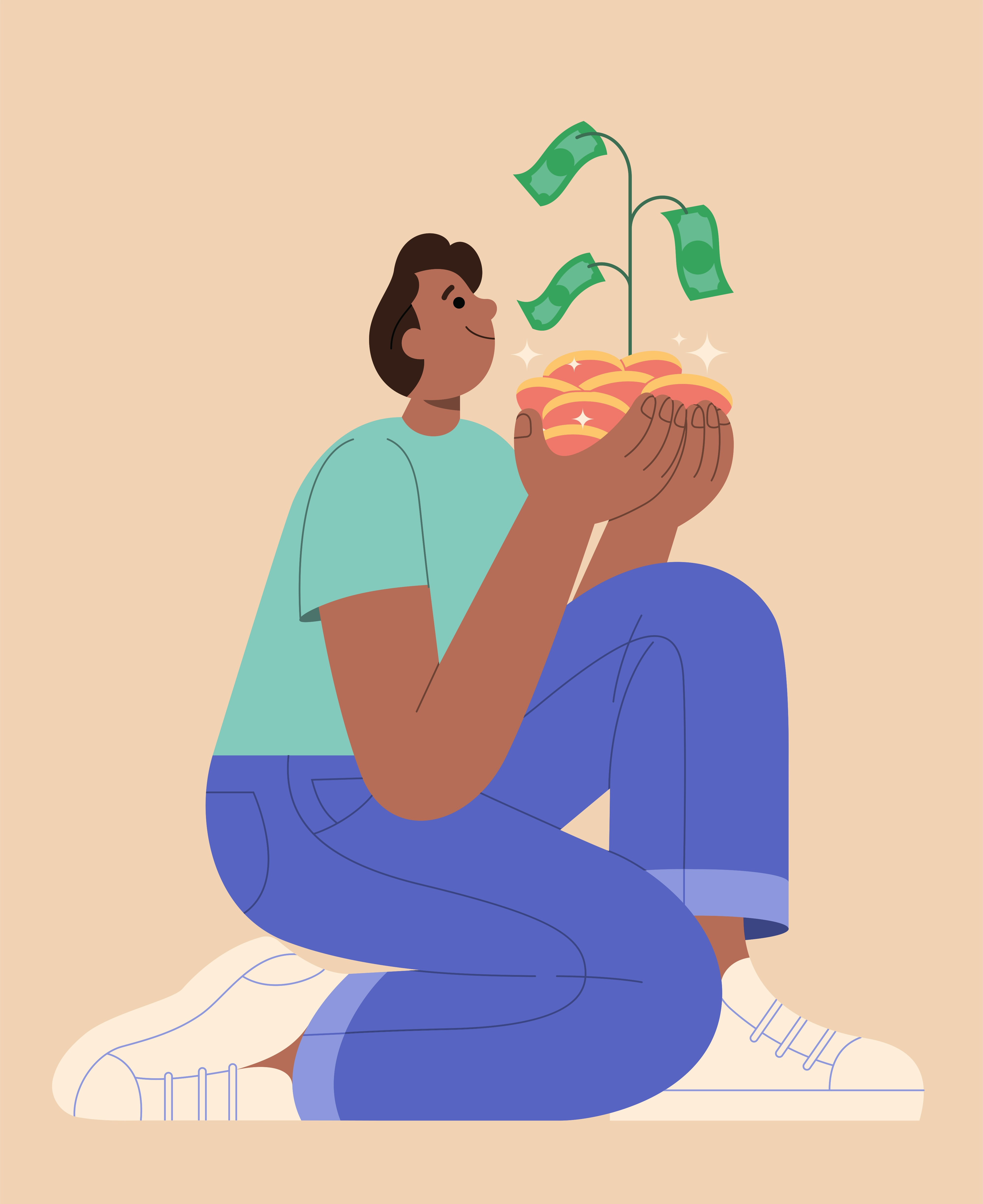
How do I write about money when I’m not making financial sense to myself right now? This is the question I’ve been grappling with.
You have probably gathered by now that I’m in-between places and things, sunsetting one venture while simultaneously trying to breathe life into a number of loosely related new ones. You may also have worked out that this is not unfamiliar territory for me. I quite enjoy these intersections between the former thing and the thing that is yet to come. It’s an opportunity to look back at how far I’ve come, look around at where I am and look ahead at where it is possible to go and recalibrate my compass.
I love where I am, creatively and entrepreneurially. A year ago I was intellectually drained, surviving on dregs and running almost exclusively on muscle memory. Now the fog has cleared, ideas are pumping through my veins again and I’m plotting wild and impossible things. I am invigorated. I spend the better part of my day thinking and talking about some of my favourite things: the power and the beauty of the written word, the business of publishing, the dissemination of compelling ideas, the making of things that matter.
I have even worked up the gall, the sheer audacity, to make the highly unfashionable prediction that books and magazines as forms of human and creative expression matter now more than ever and will continue to matter into the future. That in the not so distant future a digital glut will tip the scales so that chronically online people will pine for offline and tactile experiences and when they do they will reach for and savour good books and good magazines.
At the same time, if I draw a two-circle venn diagramme where one circle lists all the things that I am currently doing or that I want to do while the other lists all the opportunities that I can currently expect to make a living from, there will be zero overlap between the two circles. Noti, sufuri, zilch. It borders on the ridiculous just how far apart these two circles are from each other. If one is a list of seasonal vegetables, the other is a list of minerals recently discovered on Mars. That’s approximately how far.
This is not a theoretical dissonance. Yesterday morning a headhunter reached out and put before me a tempting job opportunity that aligns perfectly with my qualifications and my most recent work experience. If I confirm interest and proceed with the interview, there’s a reasonable likelihood of securing the role. I suspect that the pay would be very handsome indeed. A year ago I would have jumped at the chance: now it falls flat. It just does not align with my current preoccupations or with my evolving aspirations. Yet the idea of turning it down created an acute sense of cognitive dissonance. My cheese has moved but a girl’s still gotta think about what she’s going to eat, right? So I did not decline right away. I asked for time even though I already knew, deep down, what my answer would be. In the evening I composed a follow up message politely passing on it. It may be one of the most ludicrous things I’ve done recently but I could not not do it.
This is why I say I am not making financial sense to myself right now.
I was fretting about this to one of the Keepers the other day, the ones who remind me who I am when I forget. Because one thing that my most recent conversations have underscored is that the business of cultural production is hard. I have always known this, of course, but sometimes what we know fades out of view and gets downloaded out of short-term memory until something happens to float it back up to the surface. The thing that had floated this inconvenient fact back to the surface this time was researching three of my favourite publishers in the UK and realising that they supplement the commercial proceeds from their publishing pursuits with public grants and/or private donations. This is what it takes to get their work done. I’m not saying they wouldn’t do the work if these supplemental funds did not come in but they probably wouldn’t do as much and an aspect of the work they do would be constrained. Coming to this realisation left me feeling deflated. I have just exited a hard, hard thing. Do I really want to get into another longhaul hard thing?
She listened patiently then said, matter of factly: “We are rational people. We think about what we’re doing. We count the cost.”
That was all she said and it was all the reminder I needed. Just the balm my nervous system needed to reset itself. It is true: I’m not making financial sense to myself right now, but I am also a reasonable, rational human being and asking the right questions is a way station on the journey to finding the right answers.
So perhaps the way to write about money when I’m not making financial sense to myself is to write about the questions I’m asking myself about money and how I’m thinking about the math and to invite you into my ruminations.
For those of us who believe, the spiritual math must precede all else.
A confession: Often Jesus’ teachings can make sense to me in theory while seeming to set an impossible standard to live by on a daily basis. Take the instruction to not worry about your life, what you will eat or drink; or about your body and what you will wear in Matthew six, for example. Then, a few verses down, the oft repeated imperative to seek first his kingdom and his righteousness, and these things will be given to you as well. I get it, I think, but I don’t always know how to live it.
However, I have found philosophical resonance in Wendell Berry’s essay Two Economies, which circles and peers into this particular passage in Matthew. In the essay Berry identifies two economies that govern our world. The first is the Great Economy, which is the Kingdom of God, or the interconnected order of all living things. It is vast in design, beyond human comprehension and embedded with laws whose objective is harmony among all life. It is where all value originates. The second is the Human Economy, where human activity is concentrated. It is much narrower and constitutes human beings’ use of their abilities and tools to create and disseminate secondary value. For rudimentary example, making furniture out of trees. All things live in the Great Economy by nature, according to Berry, but human beings are unique in that although they live in the Great Economy, they can choose to live in it not on God’s terms but on their own terms. This is the nature of free will.
The Seek the kingdom first imperative in the book of Matthew is a law of the Great Economy. The point, Berry argues, is not to ignore the Human Economy, we cannot, we live in it, but rather to prioritise the Great Economy because its structure and rules are designed for us to thrive in. The Human Economy can only thrive long term if it subjects itself to the rules of the Great Economy. The Great Economy is where our worth is both assured and incalculable. The Human Economy is where the rent is due. Oswald Chambers agrees with Berry in this respect. He too emphasises that it is a matter of what we prioritise. He talks about situating God at the centre of our lives and being ‘carefully careless about everything else by comparison.’
I gravitate toward this interpretation because it boils it down to what we pay attention to and what we foreground. It is a constant reminder to subjugate the Human Economy’s bank account worries to the Great Economy’s values.
Then there’s that famous anecdote from a David Foster Wallace’s commencement speech two decades ago:
‘There are these two young fish swimming along, and they happen to meet an older fish swimming the other way, who nods at them and says, “Morning, boys, how’s the water?” And the two young fish swim on for a bit, and then eventually one of them looks over at the other and goes, “What the hell is water?””
The point being that the most obvious, most ubiquitous realities are the hardest to see and talk about.
Like capitalism, an artefact of the Human Economy, being the dominant religion of our times. To not to adhere to its demands takes constant and disciplined attuning to a different north. There’s no escaping this capitalist logic within which we live. We have to take it into account while making a life. Its demands are loud and urgent. Our landlords will not accept a verse of scripture, a short story, a painting, a compelling startup vision or a journal entry about a much needed sabbatical in lieu of rent. Nor will the Supermarket or your children’s school.
Even our language casually defines our personal value in capitalist terms: ‘What is she worth?’ is almost universally understood to mean what is the sum of her assets as measured in strictly financial terms. We boil ourselves down to the money in our pocket. We pretend that we do not, because the notion is rightly pungent, writ plain, but we do. We also tend to attach our sense of self and sense of purpose to our wealth because of this polluted water we swim in.
This is the sobering truth.
We are not the first to wrestle with the role money plays when designing the life worth living, of course.
I was reminded of this when I read Mason Currey’s Making Art and Making a Living. It’s a short book, two hundred pages odd, packed with anecdotes about how different creative types have funded their lives and endeavours through the ages, from the benign to the genuinely eyebrow raising.
Currey says his book is for the reader “powerfully drawn to a life in the arts and at the same time powerfully stumped by the difficulty of balancing those ambitions with the very real need to pay rent and put food in the fridge.” This dilemma gestures toward John Lewis Gaddis’ Grand Strategy and the tension between infinite ends and limited means. How do we reconcile grand ambition with finite means?
Currey takes a sweep of history and collates anecdotes of how dozens of artists, writers and other creative types funded their lives and their work. Not all of them are honourable and some of them are unambiguously criminal. It’s all very enlightening. Some mooched off relatives. Paul Cezanne and Louise Nevelson refused to do anything else and their families had to support them or watch them starve. Others, like the musical genius Hadyn, depended on the patronage of the wealthy. Octavia Butler worked what she labelled “horrible little jobs”: a dishwasher, telemarketer, warehouse worker and potato chip inspector, making room for her writing early in the morning, before work, starting as early as 2 am. Wallace Stevens, a Pulitzer Prize winning poet, pursued a career as insurance executive and carved out time on the side for his creative work, relieving himself of the pressure of supporting himself through his creative endeavours. Franz Kafka’s career plan also entailed “finding a dignified and secure occupation that would leave him enough time for his writing and not be so arduous as to drain him of intellectual and psychic energy.” The book has dozens more stories like these. There’s even a chapter dedicated to those who resorted to theft to fund their art and another that zeroes in on dubious get rich quick schemes. Turns out some people will go to extreme lengths to finance their own versions of a life worth living and not all of them are worth emulating.
One of the most outspoken wrestlers with the question of the role of money in a creative life is Virginia Woolf, that influential if controversial writer who lived and thrived at the turn of the last century. Her most famous assertion being that “A woman must have money and a room of her own if she is to write fiction.” Woolf carried these questions in her own life in an era when they were considered decidedly indelicate, perhaps even offensive to the bourgeois sensibilities and she came to answers that ruffled the conventional society of her time. Money, she insisted, would buy women freedom and enable them to live to their fullest. They needed their own money.
Hers was as articulate and fervent an expression as ever made of the laws of the Human Economy that we have built. But I bring up Woolf here because there are lessons to be drawn from the fine print of her assertions and from her unwavering resolve to build a life toward a particular end despite the constraints of the Human Economy. She was far FAR from a woman of faith, but she was a woman of vision appears to have understood, instinctively, the cost of making a life and the trade offs we must accept along the way.
The bad news for fish is that they cannot swim outside water. The good news for human beings is that as difficult as it is, we can negotiate an unconventional relationship with capitalism and survive.
It all begins with figuring out two things.
The first thing we need to figure out is what our number is. Five hundred a year was Woolf’s number. We know because she repeated it over and over again in A Room of One’s Own. She was clear about it and she was steady with it. This might sound like a straightforward thing to do but it is not. Leo Tolstoy tried to paint us a picture of how slippery a slope it can be. His parable, How Much Land Does a Man Need, is the cautionary tale of a peasant, Pahom, who starts out with an aspiration to acquire just enough land to live well. As the story unfolds, he acquires more and more land but with each acquisition, his appetite, rather than becoming sated, grows: as soon as he becomes accustomed to having what he has acquired, he wants more therefore he sets out to acquire more. On and on the story goes until Tolstoy presents us with the somewhat dramatic yet brutally obvious answer to the titular question.
Like Woolf, many of us start out holding a thoughtfully computed, well-intentioned number. Unlike Woolf, however, we often lose our resolve so that the closer we get to the number the further away it slides from us, always remaining at once alluringly within reach and agonisingly out of reach.
Five hundred a year was well below Woolf’s income at the time she gave her famous lectures but it was above where she had begun when she came into adulthood. She started out with an inheritance of circa nine thousand pounds that assured her and her husband a very modest income of four hundred pounds a year, inheritance being a common source of income for the upper middle class to which she belonged. It was enough to live on, albeit very modestly. Consequently, she and her sensible and like-minded life partner, Leonard Woolf, cultivated a diversified portfolio of income sources including journalism, a publishing press, and novel writing. Despite their growing income from Leonard’s journalism and the subsequent success of Woolf’s novels, they continued to live a very modest life long after their annual income expanded into the thousands of pounds.
Long after she needed to, Woolf contained her expenses in service of her life’s goals. This is the tax that visionary life may demand of us. We must ask ourselves whether we are willing to pay it.
The second thing we need to work out is the purpose of our ‘five hundred a year’ and therefore the purpose of our endeavour to acquire it. The point, hopefully, is to secure our finances not for their own sake but for what securing our finances enables us to do. The vision matters. Woolf’s vision for her five hundred a year was that it would purchase her that lock on the door that gave her the room to write and the power to think for herself. What it is for each of us is personal, but it is important to articulate it to ourselves and, where applicable, to those with whom we are in committed community and have obligations to, such as spouses and children.
In the end, we get to decide what our five hundred pounds buys us and what it saves us from. The hope, of course, is the ultimate bargain: that money would be in service of our lives rather than our lives in service of money and that the shillings and cents of the Human Economy would serve the visions and values of the Great Economy.
The emperor in Rome will have his due but we can give Caesar his due and keep our souls.
Wisdom and peace to all of us as we do our life math.