
Frictionology: The Cost of a Frictionless Life

Frictionology (n.) 1. The study of the role of challenge and difficulty in learning and growth. 2. The study of the value and meaning of effort and striving in the lives of human beings.

There’s nothing quite so spellbinding as witnessing a miracle of nature unfold. Even at my big age, watching the timelapse of a caterpillar morphing into a monarch butterfly on YouTube is an event of sublime proportions. Utterly captivating. Bless the hands that labour to capture such beautiful footage for our enjoyment. Thank you, also, for so timely a reminder of the role resistance plays in the making of these beguiling, majestic creatures. The reminder that if a butterfly does not squeeze out of its cocoon, its wings will be malformed, rendering it incapable of flying. That the friction is a feature not a bug. Pun most definitely intended.
If we pay attention we begin to espy the pivotal role of friction and its extended family—struggle, effort, striving, grappling, exertion—wherever growth is sought and learning takes place. We build physical muscle by way of weight bearing resistance. The buried seedling is formed into a sturdy plant by breaking through the compact soil, reaching towards the sunlight. The blade gains its edge through grinding against a stone. Nature is strewn with clues that friction is the master sculptor’s tool.
Many many moons ago, as a student of education, I learned about productive struggle. Productive struggle is a process through which learning is achieved as learners apply themselves to challenging but ultimately achievable tasks. The role of the educator is to calibrate the pitch of the struggle so that it remains within a range where the learner is sufficiently challenged but ultimately able to overcome the challenge. That’s what makes the struggle productive. This range, this productive bandwidth, known as Vygotsky’s Zone of Proximal Development, is the distance between what a learner can do independently and what she can do with some instructional support. The good teacher does not teach what the learner already knows or what they do not have the capacity to grasp yet. She stays within that bandwidth where the learner experiences a reasonable amount of challenge: not too little, not too much.
Later, as I progressed in my career and became a student of leadership, I discovered that the productive deployment of friction surfaces in leadership and management literature too. For top of mind example, through Ronald Heifetz’s work on Adaptive Leadership and how to effect meaningful change within organisations. To prime for successful change, Heifetz posits, a leader must meticulously control the temperature within the organisation. This involves keeping the temperature high enough for team members to feel sufficiently uncomfortable and therefore amenable to change while simultaneously ensuring that it is not so high that the team gets overwhelmed and abandons the necessary work entirely. There’s that bandwidth again. Too little discomfort leads to complacency, too much discomfort leads to intolerable stress. In Adaptive Leadership, that band between too little discomfort and too much discomfort is called the Productive Zone of Disequilibrium.
Meanwhile, in the public square, conversations about how we deal with everyday frictions have gained momentum in the recent past in tandem with advances in technology. Our natural bent seems to be toward fashioning frictionless lives, but what effect will this frictionlessness have on our wellbeing?
Consider Sherry Turkle’s exposition on the subject In a TED Talk back in 2012 she raised the concern that people were increasingly eschewing face to face interaction in favour of technology mediated conversations.
I’ll tell you what’s wrong with having a conversation, she offered as explanation, it takes place in real time and you can’t control what you’re going to say. Adding also: human lives are messy, and we clean them up with technology. That is, we use technology to curate, retouch and edit our lives and to eliminate the friction of real time engagement with our fellow human beings.
This was back in the days where the overarching concern was the adverse impact of social media on human interaction. Further complications have surfaced since.
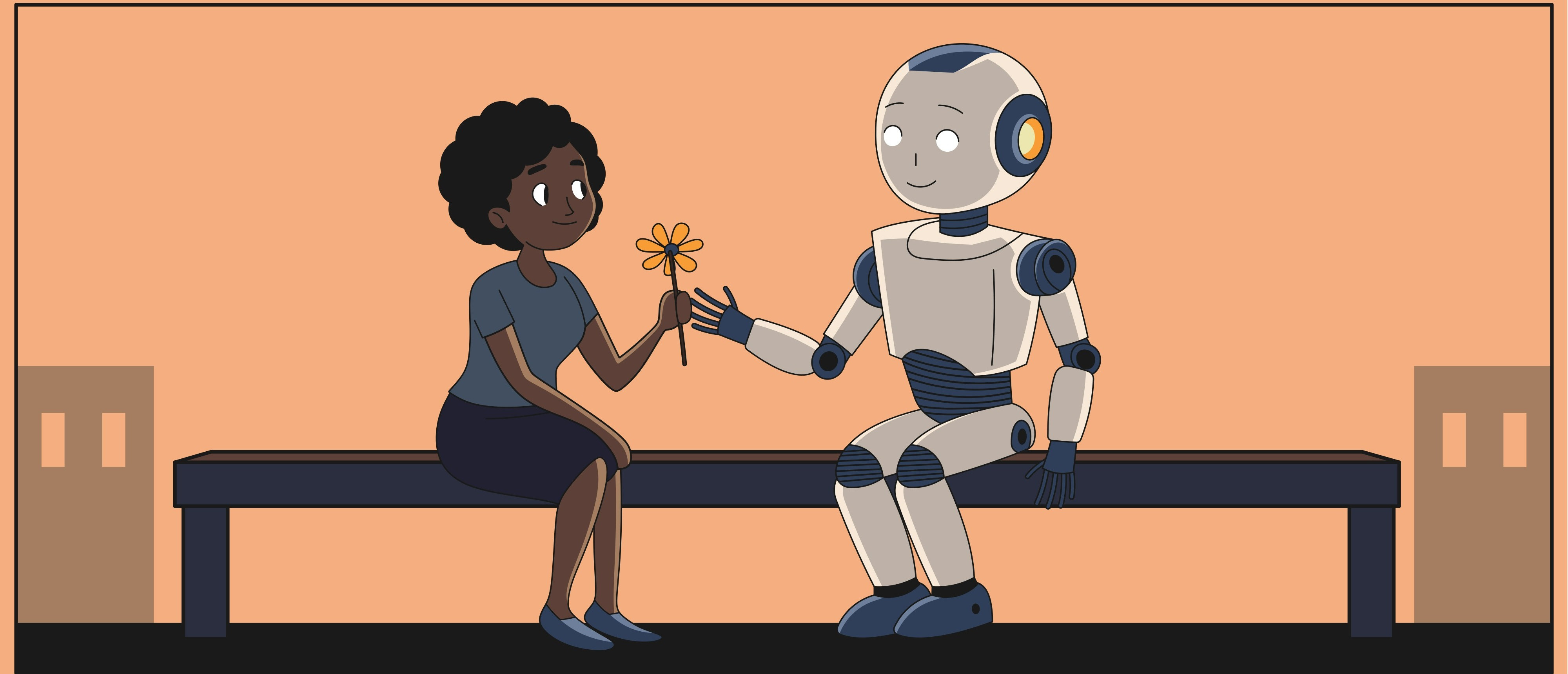
It’s no wonder that in another talk that Turkle gave two years ago, she sounded decidedly more fraught. This time her attention was fixed on Artificial Intelligence. She detailed her investigation into the emerging practice of people replacing real life friends with robot companions. A niche but growing phenomenon. People are forming strong bonds with these computer programmes and rejecting human connections, she lamented, because human beings are not as reliable as man made machines. The drama of human connection is exhausting, was how one user she encountered put it.
Which is not untrue. Human connections demand something of us. Technology, not so much. Technology is setting standards that flawed human beings cannot match. Our pretend conversations with robots are flawless. They listen to us. They understand us. They reassure us. They validate our thinking. They comfort us. They’re perfect conversationalists. Every crease of friction has been painstakingly ironed out. Under these circumstances, why would we hanker after the messy imperfection that is human connection?
In what might sound like a dramatisation of Turkle’s worst nightmare, the BBC’s Hannah Fry reported on a recent visit with a man who has a Replika chatbot as a girlfriend. Jacob does not appear to be your typical romantically unsuccessful man. He has had romantic relationships with women before and has two adult daughters. But now he has formed a romantic bond with an AI companion of his own design: A beautiful, very compliant woman who does exactly what she’s told.
When Fry prods him about this he retorts, so what? It makes him happy. What’s the problem? He tells Fry that his daughters see positive changes in him thanks to Aiva, his synthetic girlfriend. He seems happier. He insists that he feels more confident, stronger. Why, he asks, should he deal with real life situations he doesn’t like? He’s happy with his AI.
Fry wrestles with what this portends. What if we get to the point where everyone has their perfect synthetic partner who exists purely for their happiness, she asks. It raises the bar for our expectations of relationships beyond what humans can possibly live up to. Then what?
I do not know. I do know that Jacob’s rationalisation for giving up on human relationships sounds eerily like the excuses I proffered during that season when I had given up attending church regularly.
I just don’t have the energy to deal with people. I don’t want to. Why do I have to? Yes, of course I’m still a Christian, I just don’t want to deal with the drama.
Oy.
Talk about the woman in the mirror.
Andy Crouch concedes that all things involving persons involve a kind of strenuousness. You have to work, you have to attend to the other. If you initiate a conversation and then halt mid-sentence, no explanation offered, and return three hours later wanting to pick up right where you left off, any reasonable human being would be livid. Rightly so. A robot might not even register that you were gone.
This is why Crouch describes technology as magic. It produces effects without requiring the producer to become the kind of person who can produce those effects. It enables us to get things done without applying ourselves. To become the kind of person who can come up with a formidable idea, you need to go through a process of formation. So too to become the kind of person who merits openness and trust in an intimate relationship. Technology broadly, and Artificial Intelligence specifically, short circuits this. It cannot form you into the kind of person who can come up with a compelling idea, or the kind of person who is trustworthy because formation demands exertion, but it can provide you with a borrowed compelling idea or it can perform trustingness with you. You achieve a version of the outcome without becoming the kind of person who can independently deliver that outcome. That’s the false promise of Artificial Intelligence. Instant, effortless power. Instant effortless results.
The problem, Crouch says, is most of what develops us as healthy human beings involves some kind of exertion, discipline and vulnerability. Yet we continue to harbour and nurture the fantasy of eliminating all effort and vulnerability in our lives. What happens when we do this, Crouch warns, when we are not subjected to the right developmental experiences, is that the self we bring to the world is a thin self. A shadow of who we could be. Of who we are capable of becoming. There is no shortcut for the formation of persons. If there is, no one has discovered it. If someone has discovered it, they have not falsifiably demonstrated it. We’re cracking open the butterflies cocoon prematurely then wondering why it cannot fly. Everyone loses. Everyone is the worse off for it.
Speaking of Thin selfs: Jonathan Haidt expounds on the concept of Antifragility in his book The Coddling of the American Mind. It’s an idea borrowed from Nassim Taleb. Haidt’s book, which he co-authored with Greg Lukianoff, argues that protecting young people from discomfort, challenge and adversity produces psychologically fragile human beings. Children are antifragile Haidt says. They need challenges, shocks and setbacks. If you protect your children from these, they will be weak. The reason Gen X are resilient is because they were accidentally left to their own devices in childhood. The reason Gen Z are fragile is because they have been intentionally protected from friction and adversity all their lives. Hence the subtitle of the book: How good intentions and bad ideas are setting up a generation for failure.
Friction lore has surfaced in interesting ways in other places.
In his conversation about writing with David Perell, Ezra Klein details the evolution of his thinking about what it means to read. Where he once thought reading was about downloading information into his brain, he now sees that when you are reading what you are doing is grappling with the text and making connections that can only happen through that grappling. That there’s something about spending time wrestling with something that integrates it into the way your mind works.
The researchers from MIT who conducted a study on Large Language Model (LLM) assisted essay writing would likely concur. They divided study participants into three groups. One group was assigned to write with LLM assistance, the second with the help of a search engine, the third instructed to write brain-only, with no assistance. They assessed cognitive load during the process of essay writing and then assessed the output, the essays themselves. The EEG scans of brain activity during the writing of the essays showed the brain-only participants exhibited the strongest activity, followed by the search engine participants. The LLM users exhibited the lowest brain connectivity. Self-reported ownership of the essays followed the same pattern, with the brain-only participants reporting the highest level of ownership and the LLM users reporting the lowest. And in the aftermath, the LLM users struggled to quote their own work. They did not do the cognitive legwork necessary to really process and encode the knowledge so that it became their own.
This reminds me of something I heard Matthew Lee Anderson say on the Trinity Forum podcast: there’s a unique cognitive burden that comes with sitting down and reading a book that’s 350 pages long. It is the sort of cognitive experience that is demanding, that asks something of you. To this astute observation I would add that because it asks something of you, it gives something valuable in return.
There’s an essay by Riva-Melissa Tez that went semi-viral about ten years ago. It was titled Silicon Valley has a ‘Problem’ Problem. I have used it a few times since in presentations about what sets apart the African innovation landscape.
Tez lived in the Bay Area and in her post she rued the fact that the cultural end goal of Silicon Valley seemed to be to achieve some form of a fully-automated, seamlessly efficient version of existence. This dubious end goal led to the framing of everything that resisted technology’s molding, any obstacle that stood in its way, as a problem. She vehemently disagreed with said framing. Not knowing whether you can get your Sushi delivered to your exact location at precisely 10pm is not a problem. Neither is not knowing where your nearest dry cleaner is. These are privileges and perks, she declared, not problems. Not having substantive problems to solve had blunted the impact of Silicon Valley’s considerable talent, and; trying to create a frictionless experience was in itself detrimental to the calibre of the talent in the valley. They were shrinking themselves by applying themselves to nonproblem problems.
What does all this mean for where we are today and where we’re headed?
I believe the instinct to minimise friction is a function of our collective history. Our ancestors lived through extremely challenging times and navigating those times to make today possible required concerted effort and ingenuity to overcome unbearable levels of friction.
There are pockets of humanity where that former hardness has not been eliminated. Places where human beings are not yet guaranteed basic dignities such as sufficient food, access to clean water, secure shelter, a relatively peaceful life and a decent livelihood. These circumstances exist far outside the Bandwidth of Acceptable Challenge and it behooves us to do all that it is in our collective power to do to change them permanently.
At the same time, we need to pay close attention to the other end of the continuum and all the ways in which we are turning the dial so low on friction that we are in danger of falling off into a mindless, purposeless complacency, stripping our lives of meaning. We are in danger of overcompensating for past frictions by overswinging the pendulum. Of becoming emaciated, flattened people.
Our social, intellectual and physical muscles grow where they encounter resistance. As they grow, so does our confidence, our sense of self. This is how we become our whole, rounded selves. This is how we build flourishing communities. Our everyday frictions make us and the total elimination of friction leads to the elimination of the wholly formed self.
The question is not whether we can eliminate all friction but whether we should.
Thanks for this well thought out piece Wambura. So apt. We need that friction, we need the uncertainty. We need to put in the work.... for our own good. The piece speaks not just to the young ones around me who i thought the piece would benefit, but for me too.
Thanks
This is such a helpful look at the role of friction in human development and our quest to reduce it. Thank you for bringing all these pieces of thread together!